The Socio-Cultural Dimensions of Communication
Article Sidebar
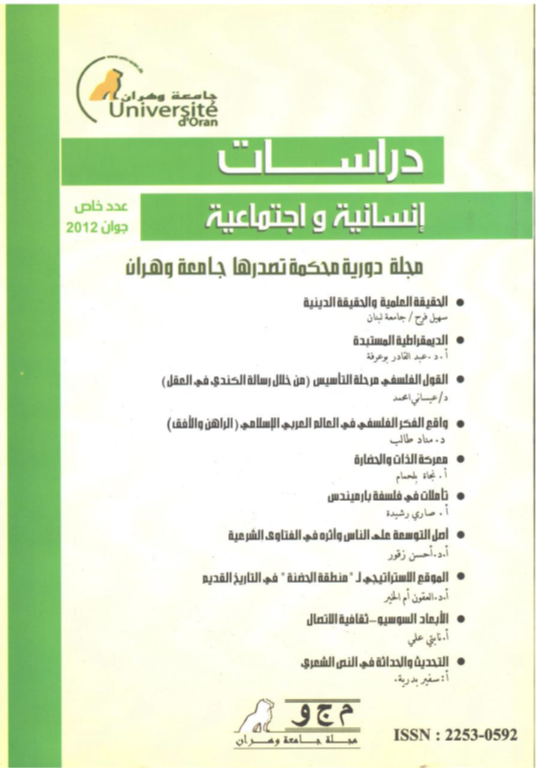
Main Article Content
Abstract
This study examines communication as a multidimensional socio-cultural process that extends beyond the conventional sender–receiver model to encompass the symbolic, psychological, spatial, and cultural structures governing human interaction. Adopting a sociological and analytical approach, the paper explores major theoretical perspectives developed by Émile Durkheim, George Herbert Mead, Erving Goffman, Pierre Bourdieu, Edward T. Hall, Claude Lévi-Strauss, and other scholars whose contributions have shaped contemporary communication studies. The analysis demonstrates that communication is fundamentally embedded in systems of social interaction, symbolic representations, collective beliefs, cultural values, and institutional norms that define interpersonal and collective relationships. Furthermore, the study highlights the role of rituals, symbolic practices, habitus, identity formation, and socio-spatial contexts in structuring communicative behavior and sustaining social cohesion. Particular attention is devoted to intercultural communication, showing how differences in symbolic codes, spatial perception, temporal orientation, and cultural conventions generate both opportunities for mutual understanding and sources of misunderstanding. The paper argues that communication should be understood as a dynamic social institution through which cultures reproduce meanings, negotiate identities, and organize collective memory. Consequently, successful communication depends not only on linguistic competence but also on the capacity to interpret the cultural frameworks that shape human interaction. The study concludes that communication constitutes an integrated socio-cultural phenomenon in which symbolic systems, social structures, and cultural practices interact to produce and reproduce social order, making it an essential analytical framework for understanding contemporary societies and intercultural relations
Article Details

Copyright Notice
Authors retain copyright and grant the journal right of first publication with the work simultaneously licensed under a Creative Commons Attribution 4.0 International License (CC BY 4.0).
This allows others to share the work with an acknowledgement of the work's authorship and initial publication in this journal[cite: 2, 11].
The journal allows authors to deposit the Version of Record (published version) in an institutional or other repository of their choice without any embargo period.
References
Benveniste, É. (1966). Problèmes de linguistique générale. Paris: Gallimard.
Bourdieu, P. (1980). Le sens pratique. Paris: Éditions de Minuit.
Bourdieu, P. (1987). Choses dites. Paris: Éditions de Minuit.
Durand, G. (1984). L'imagination symbolique (4th ed.). Paris: Presses Universitaires de France.
Enriquez, E. (1983). De la horde à l'État. Paris: Gallimard.
Fischer, G. N. (1986). Psychologie des espaces de travail. Paris: Armand Colin.
Giddens, A. (1987). La Constitution de la société. Paris: Presses Universitaires de France.
Goffman, E. (1973). La mise en scène de la vie quotidienne. Paris: Éditions de Minuit.
Goffman, E. (1974). Les rites d'interaction. Paris: Éditions de Minuit.
Gumperz, J. J. (1982). Language and Social Identity. Cambridge: Cambridge University Press.
Hall, E. T. (1959). The Silent Language. New York: Doubleday.
Lévi-Strauss, C. (1977). L'identité. Paris: Grasset.
Tap, P. (1986). Identités collectives et changements sociaux. Toulouse: Privat.