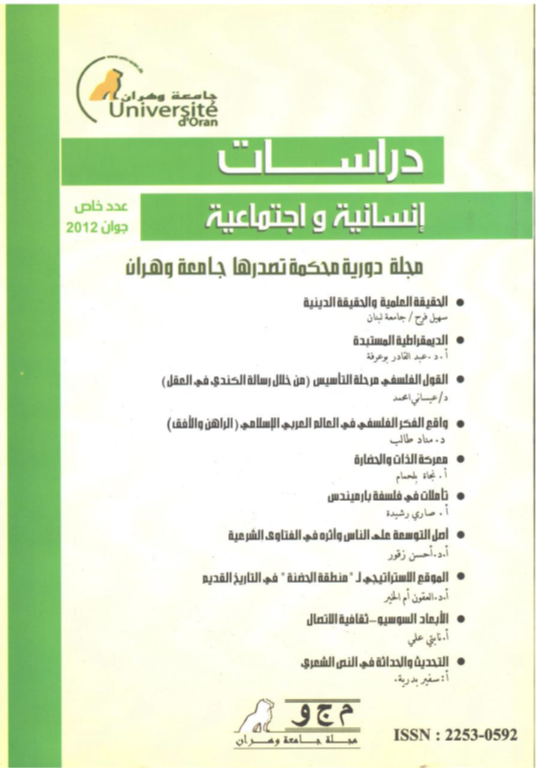
Scientific truth and religious truth
Article Sidebar
Main Article Content
Abstract
This paper examines the philosophical relationship between scientific truth and religious truth through a critical epistemological analysis that challenges the reductionist tendency to privilege one form of truth at the expense of the other. Drawing upon the history of philosophy, philosophy of science, and religious thought, the study analyzes the conceptual foundations of truth and distinguishes between its scientific, metaphysical, and religious dimensions. Adopting an analytical and comparative methodology, the paper argues that scientific truth is characterized by empirical verification, methodological revision, and provisional validity, whereas religious truth derives from existential experience, symbolic interpretation, ethical commitment, and spiritual meaning. Rather than viewing these two domains as mutually exclusive, the study proposes that they represent complementary modes of understanding reality, each governed by its own epistemological principles and methodological framework. Through a critical discussion of classical and contemporary philosophical perspectives—including Plato, Aristotle, Spinoza, Hegel, Heidegger, Ricoeur, Popper, Bachelard, Foucault, and Teilhard de Chardin—the paper demonstrates that neither scientific rationality nor religious faith can claim exhaustive knowledge of existence. Scientific inquiry continuously revises its conclusions in light of new evidence, while religious consciousness addresses dimensions of human existence that transcend empirical observation, including value, purpose, transcendence, and moral responsibility. The study concludes that the apparent conflict between science and religion results primarily from epistemological confusion and methodological reductionism rather than from an intrinsic incompatibility. A productive dialogue between scientific knowledge and religious wisdom therefore requires recognition of the autonomy, legitimacy, and complementarity of both forms of truth in constructing a comprehensive understanding of humanity, nature, and the cosmos.
Article Details

Copyright Notice
Authors retain copyright and grant the journal right of first publication with the work simultaneously licensed under a Creative Commons Attribution 4.0 International License (CC BY 4.0).
This allows others to share the work with an acknowledgement of the work's authorship and initial publication in this journal[cite: 2, 11].
The journal allows authors to deposit the Version of Record (published version) in an institutional or other repository of their choice without any embargo period.
References
Foucault, M. (1975). Surveiller et punir. Paris: Gallimard.
Heidegger, M. (1964). L'être et le temps. Paris: Gallimard.
Morin, E. (1989). L'erreur de sous-estimer. Paris.
Nietzsche, F. Œuvres posthumes. Paris: Mercure de France.
Popper, K. (1980). Conjectures and Refutations (Arabic translation cited in the article). Rabat: Al-Bayader.
Ricoeur, P. (1964). Histoire et vérité. Paris: Éditions du Seuil.
Spinoza, B. (1677). Ethique. Paris: Flammarion.
Stace, W. T. (1998). Religion and the Modern Mind (A. A. Imam, Trans.). Cairo: Maktabat Madbouly.
Teilhard de Chardin, P. (1994). Science and Christ (Arabic ed.). Beirut: Pastoral Center for Research and Studies.
Charon, J. (1977). L'esprit, cet inconnu. Paris: Albin Michel.
Ibn ʿArabī. (n.d.). Al-Tajalliyāt. Beirut: Dār Iḥyāʾ al-Turāth al-ʿArabī.