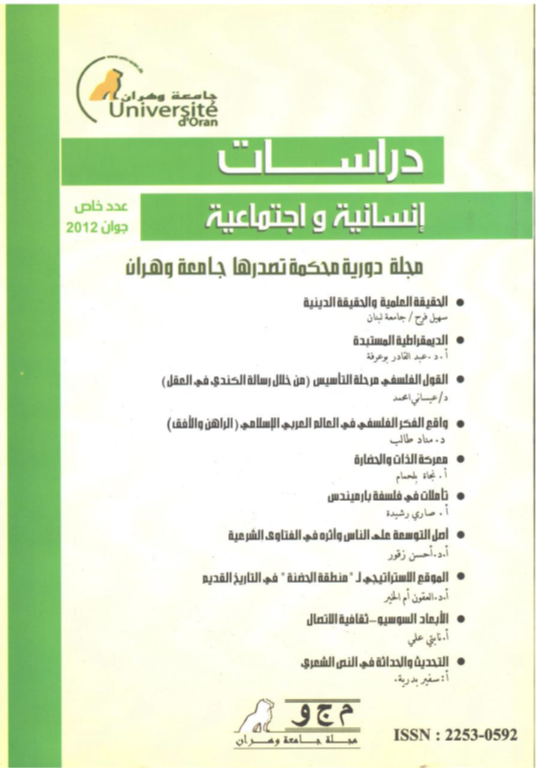
The Formation of Philosophical Discourse من خلال رسالة الكندي في العقل
Article Sidebar
Main Article Content
Abstract
This study examines the formative stage of philosophical discourse in classical Islamic thought through an analytical reading of Al-Kindī’s Treatise on the Intellect. Adopting a historical, philosophical, and hermeneutic approach, the paper argues that Al-Kindī did not merely reproduce Aristotelian psychology but reinterpreted the theory of the intellect within an Islamic epistemological framework that reconciled Greek philosophical heritage with the intellectual demands of medieval Islamic civilization. The study analyzes Al-Kindī’s classification of the intellect into distinct levels, emphasizing the transition from potential intellect to actual intellect and finally to practical or manifest intellect as stages in the realization of human knowledge. It further demonstrates that Al-Kindī transformed the Aristotelian concept of the Active Intellect by integrating metaphysical principles rooted in Islamic theology, thereby establishing a coherent theory of knowledge that links intellectual cognition with human action and ethical responsibility. The paper also explores the relevance of Al-Kindī’s conception of reason to contemporary philosophical debates on rationality, humanism, and practical reason, highlighting its resonance with modern discussions developed by Martin Heidegger and Fathi Triki concerning human existence, rational agency, and the relationship between theoretical and practical thought. The study concludes that Al-Kindī’s philosophy represents a decisive moment in the foundation of Arabic-Islamic philosophical discourse by constructing an original synthesis between revelation, rational inquiry, and ethical practice. This synthesis established the epistemological conditions for the subsequent development of Islamic philosophy and continues to offer valuable insights for contemporary reflections on reason, interpretation, and the human condition.
Article Details

Copyright Notice
Authors retain copyright and grant the journal right of first publication with the work simultaneously licensed under a Creative Commons Attribution 4.0 International License (CC BY 4.0).
This allows others to share the work with an acknowledgement of the work's authorship and initial publication in this journal[cite: 2, 11].
The journal allows authors to deposit the Version of Record (published version) in an institutional or other repository of their choice without any embargo period.
References
Al-Kindī. (1985). Rasāʾil al-Kindī al-Falsafiyyah (M. A. Abu Rida, Ed.). Cairo: Dar al-Fikr al-'Arabi.
Badawi, A. (1971). Commentaries on Aristotle Lost in Greek and Other Treatises. Beirut: Dar Al-Machreq.
Badawi, A. (1983). Philosophical Treatises of Al-Kindī, Al-Fārābī, Ibn Bājjah, and Ibn ʿAdī. Beirut: Dar Al-Andalus.
De Boer, T. J. (1981). The History of Philosophy in Islam (M. A. Abu Rida, Trans.). Tunis: Tunisian Publishing House & Algerian National Book Foundation.
Heidegger, M. (1984). What Is Philosophy? What Is Metaphysics? (F. Kamel & M. Ragab, Trans.). Cairo: Dar Al-Thaqafa.
Triki, F. (1998). Reason and Freedom: A Study in Rationality (Taʿaqquliyya). Tunis: Tibr al-Zamān.
Tizini, T. (1971). Toward a New Vision of Medieval Arab Thought. Damascus: Dar Dimashq.
Yefut, S. (1990). Archaeology of Arab-Islamic Knowledge. Beirut: Dar Al-Tali'a.
Ziyada, R. J. (2000). "Humanism in Arab Thought." Al-Kalima, 29.