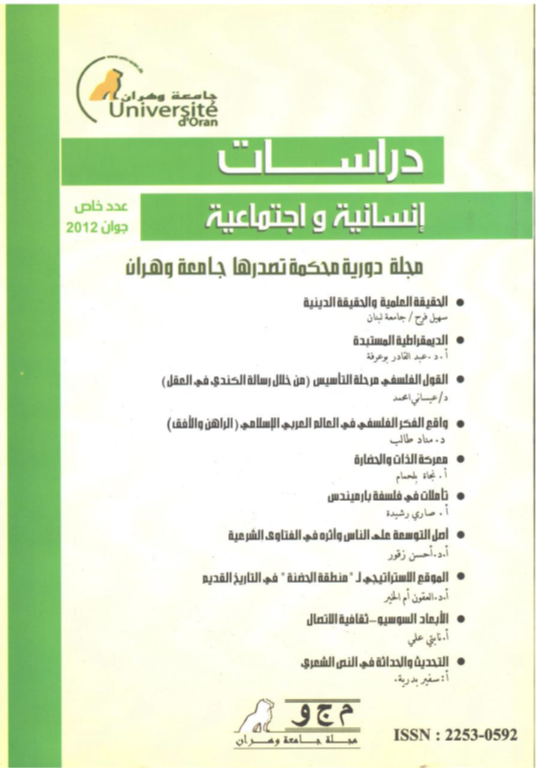
The State of Philosophical Thought in the Arab-Islamic World: Present Challenges and Future Prospects
Article Sidebar
Main Article Content
Abstract
This study critically examines the current state of philosophical thought in the Arab-Islamic world by analyzing its historical development, intellectual orientations, and capacity to address the contemporary challenges of civilizational renewal. Adopting a historical, analytical, and critical methodology, the paper investigates the concept of Nahda (renaissance) and traces its transformation from its European historical origins to its reformulation within modern Arab-Islamic intellectual discourse. The analysis demonstrates that the Arab renaissance project has been characterized by competing intellectual paradigms, including traditional reformism, Islamic modernism, secular liberalism, and Western-oriented approaches, each proposing different strategies for overcoming political decline, cultural stagnation, and intellectual fragmentation. The study argues that the limited success of these reform projects stems from methodological inconsistencies, ideological polarization, and the absence of a coherent philosophical framework capable of reconciling authenticity with modernity. It further highlights that many reform movements either confined themselves to an exclusive reading of Islamic heritage or adopted Western models without adequate critical adaptation to Arab-Islamic historical and cultural realities. The paper concludes that the future of philosophical thought in the Arab-Islamic world depends on reconstructing an autonomous critical reason grounded in rational inquiry, historical consciousness, and creative engagement with both Islamic intellectual heritage and universal philosophical achievements. Such a reconstruction requires moving beyond the dichotomy of imitation and rejection toward an integrative philosophy capable of generating an indigenous model of civilizational renaissance responsive to contemporary social, political, and cultural transformations.
Article Details

Copyright Notice
Authors retain copyright and grant the journal right of first publication with the work simultaneously licensed under a Creative Commons Attribution 4.0 International License (CC BY 4.0).
This allows others to share the work with an acknowledgement of the work's authorship and initial publication in this journal[cite: 2, 11].
The journal allows authors to deposit the Version of Record (published version) in an institutional or other repository of their choice without any embargo period.
References
Burckhardt, J. (1896). La civilisation en Italie au temps de la Renaissance (M. Schmitt, Trans., 2nd ed.). Paris: Librairie Plon.
Delumeau, J. (1997). L'Italie de la Renaissance à la fin du XVIIIe siècle. Paris: Armand Colin.
Al-Jābirī, M. ʿĀbid. (1987). Takwīn al-ʿAql al-ʿArabī [The Formation of Arab Reason] (3rd ed.). Casablanca: Centre for Arab Unity Studies.
Al-Jābirī, M. ʿĀbid. (1988). Al-Khiṭāb al-ʿArabī al-Muʿāṣir: Dirāsah Taḥlīliyyah Naqdiyyah [Contemporary Arab Discourse: A Critical Analytical Study]. Casablanca/Beirut: Centre for Arab Unity Studies.
Ibn Taymiyyah, A. (n.d.). Al-Siyāsah al-Sharʿiyyah fī Iṣlāḥ al-Rāʿī wa al-Raʿiyyah. Cairo.
Riḍā, M. R. (1931). Tārīkh al-Ustādh al-Imām Muḥammad ʿAbduh. Cairo: Al-Manār Press.
ʿAbduh, M., & Al-Afghānī, J. al-Dīn. (n.d.). Al-ʿUrwah al-Wuthqā. Beirut: Dār al-Kitāb al-ʿArabī.
Al-Muḥāfiẓah, ʿA. (1980). Intellectual Trends among the Arabs in the Age of the Nahda (1798–1914) (4th ed.). Beirut: Al-Ahliyyah Publishing.
Wuqaydah, M. (2002). “Toward a New Formulation of the Questions of the Nahda.” In Ḥamīdah al-Nayfar (Ed.), Why Did the Arab Renaissance Fail? (1st ed.). Damascus: Dār al-Fikr.