A The Strategic Location of the Hodna Region in Ancient History
Article Sidebar
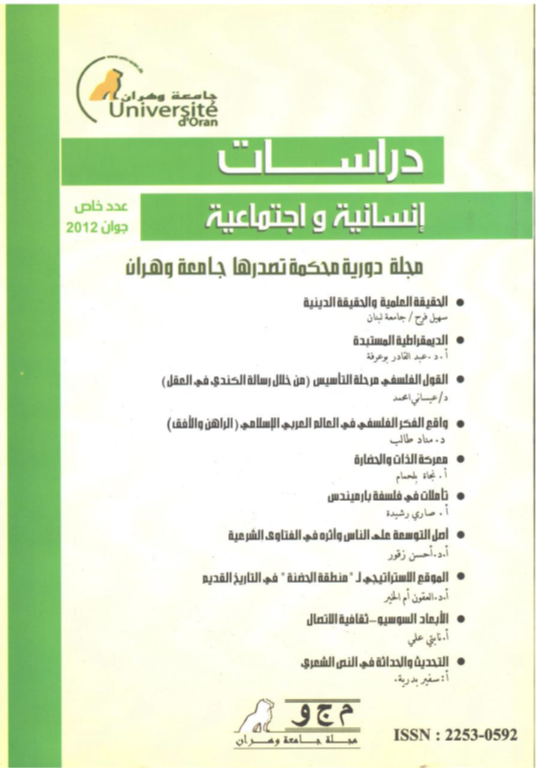
Main Article Content
Abstract
This study examines the strategic significance of the Hodna region in ancient North Africa by analyzing the interaction between its geographical setting, natural resources, and historical development. Located between the Tell Atlas and the northern Sahara, Hodna constituted a transitional zone that connected northern and southern territories while simultaneously serving as a defensive frontier. Adopting a historical-analytical approach, the study investigates how the region's topography, water resources, and communication routes shaped patterns of prehistoric settlement and later attracted Roman expansion. The research demonstrates that Roman authorities recognized Hodna as a region of exceptional military and economic value, establishing fortified settlements, defensive lines (Limes), roads, and hydraulic infrastructures to secure agricultural production, commercial exchanges, and imperial frontiers. At the same time, these policies generated continuous resistance among indigenous populations seeking to recover their lands and preserve their political autonomy. Archaeological evidence and historical sources further reveal that Hodna evolved into an important urban and commercial center where military installations coexisted with flourishing civil settlements sustained by sophisticated water-management systems. The study concludes that the strategic importance of Hodna was not determined solely by its geographical location but by the dynamic interaction of environmental, economic, military, and political factors, making it one of the principal geopolitical crossroads of ancient Algeria and a key element in understanding the historical evolution of North Africa.
Article Details

Copyright Notice
Authors retain copyright and grant the journal right of first publication with the work simultaneously licensed under a Creative Commons Attribution 4.0 International License (CC BY 4.0).
This allows others to share the work with an acknowledgement of the work's authorship and initial publication in this journal[cite: 2, 11].
The journal allows authors to deposit the Version of Record (published version) in an institutional or other repository of their choice without any embargo period.
References
Baradez, J. (1949). Fossatum Africae. Alger.
Benabou, M. (1976). La résistance africaine à la romanisation. Paris: Maspero.
Courtois, C. (1955). Les Vandales et l'Afrique. Paris.
Despois, J. (1942). La bordure saharienne de l'Algérie orientale. Revue Africaine, 86.
Despois, J. (1953). Le Hodna. Paris: Presses Universitaires de France.
Gsell, S. (1912). Atlas Archéologique de l'Algérie (Vol. 2). Alger.
Mesnage, J. (1913). Romanisation de l'Afrique. Paris: Gabriel Beauchesne.
Vaufrey, R. (1955). Préhistoire de l'Afrique. Tome I: Le Maghreb. Paris: Librairie Masson.
Wilmanns, G. (1881–1959). Corpus Inscriptionum Latinarum (Vol. VIII). Berlin.
شنيتي، م. ب. (1984). التغيرات الاقتصادية والاجتماعية في المغرب أثناء الاحتلال الروماني. الجزائر: المؤسسة الوطنية للكتاب.
شنيتي، م. ب. (1999). الجزائر في ظل الاحتلال الروماني (ج1). الجزائر: ديوان المطبوعات الجامعية.