Penser sa Vie et Vivre sa Pensée.
Article Sidebar
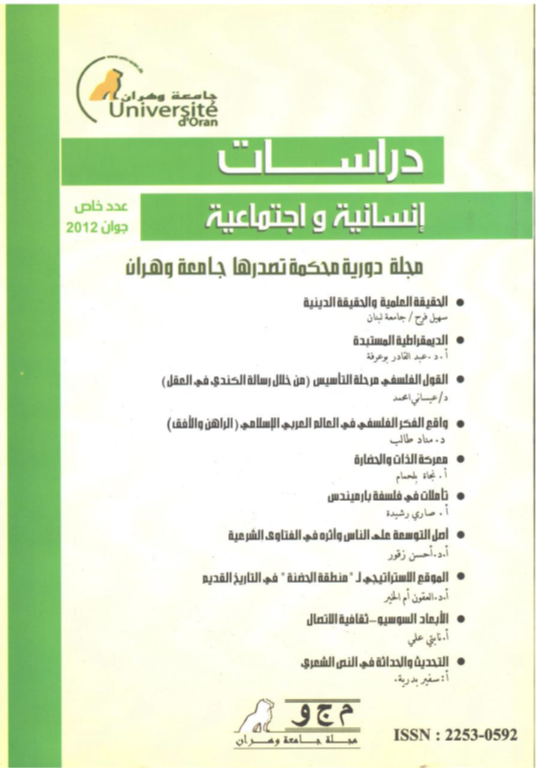
Main Article Content
Abstract
This paper examines the philosophical relationship between thought and action through a critical analysis of the concepts of thinking one's life and living one's thought. Adopting an analytical and hermeneutic approach, the study argues that human existence cannot be understood solely through rational reflection or practical action, but through their dynamic and continuous interaction. Drawing on major philosophical traditions, including existentialism, phenomenology, personalism, and action theory, the paper explores how human beings construct their identity by transforming thought into lived experience and by subjecting action to ethical reflection. Particular attention is devoted to the contributions of Heidegger, Sartre, Blondel, Ricoeur, Jaspers, Nietzsche, Habermas, and Alain in explaining the dialectical relationship between self-consciousness, freedom, responsibility, communication, and coexistence with others. The analysis demonstrates that authentic existence requires the integration of reflective thought with responsible action, thereby overcoming the traditional opposition between theory and praxis. It further argues that neither thought nor action possesses an autonomous meaning; each derives its significance from its reciprocal relation to the other and from its orientation toward human dignity, moral responsibility, and historical becoming. The study concludes that philosophical wisdom consists not in privileging contemplation over action or vice versa, but in achieving an ethical reconciliation between reflection and practice. Such reconciliation enables individuals to transcend alienation, cultivate authentic freedom, and participate actively in the continuous construction of both personal identity and collective humanity. Ultimately, thinking life and living thought emerge as complementary dimensions of an integrated philosophical anthropology grounded in responsibility, dialogue, and humanistic values.
Article Details

Copyright Notice
Authors retain copyright and grant the journal right of first publication with the work simultaneously licensed under a Creative Commons Attribution 4.0 International License (CC BY 4.0).
This allows others to share the work with an acknowledgement of the work's authorship and initial publication in this journal[cite: 2, 11].
The journal allows authors to deposit the Version of Record (published version) in an institutional or other repository of their choice without any embargo period.
References
Alquié, F. (1968). Le Désir d'Éternité. Paris: Presses Universitaires de France.
Blondel, M. (1949). L'Action (Vol. I). Paris: Presses Universitaires de France.
Blondel, M. (1954). L'Action (Vol. II). Paris: Presses Universitaires de France.
Camus, A. (1942). Le Mythe de Sisyphe. Paris: Gallimard.
Gurvitch, G. (1968). Traité de sociologie (2 vols.). Paris: Presses Universitaires de France.
Habermas, J. (1984). The Theory of Communicative Action (Vol. I). Boston: Beacon Press.
Heidegger, M. (1989). Being and Time (F. Vézin, Trans.). Paris: Gallimard.
Heidegger, M. (1992). Qu'appelle-t-on penser? (What Is Called Thinking?). Paris: Presses Universitaires de France.
Jaspers, K. (1971). Philosophy of Existence. Philadelphia: University of Pennsylvania Press.
Mounier, E. (1962). Introduction aux existentialismes. Paris: Gallimard.
Philibert, M. (1971). Ricoeur. Paris: Seghers.
Sartre, J.-P. (1966). Existentialism Is a Humanism. Paris: Nagel.